OSG Report 74: New Human Rights Report Documents Continued Killings, Forced Conscription and Displacement in Oromia

Published Sept. 7, 2026, 10:36 p.m. by FNN
22


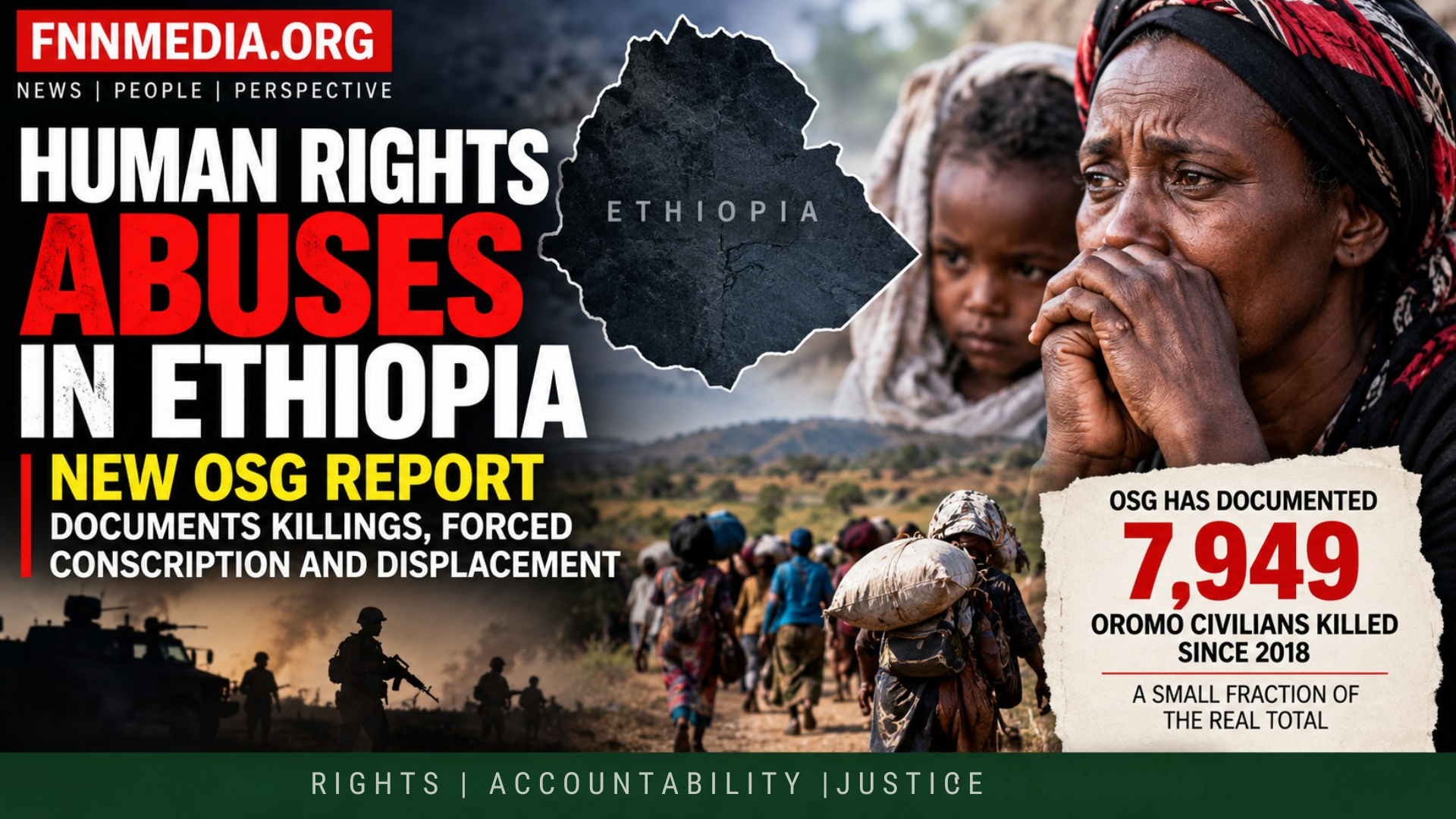
FINFINNE — September 7, 2026 — The Oromia Support Group (OSG) has released its latest human rights report, documenting continued killings, arbitrary detention, forced conscription, sexual violence, displacement and destruction of property across Oromia and other parts of Ethiopia.

OSG Report 74, dated September 7, 2026, covers developments in Ethiopia and the wider Horn of Africa and includes a submission prepared for the 63rd session of the United Nations Human Rights Council. The report says human rights violations continue to affect communities across Ethiopia, while highlighting what it describes as particularly serious abuses against Oromo civilians.

According to OSG, the organization has now documented 7,949 killings of Oromo civilians in Ethiopia since 2018, while emphasizing that the figure represents only a fraction of the actual number of deaths. The report also says that hundreds of civilians have been killed since April 2026, with violence reported in multiple zones of Oromia.

The report identifies Horo Guduru, East Wallega, West Wallega, West Showa, Hararge, Showa, Arsi and other parts of Oromia as areas where killings and other abuses have continued. OSG reports that government forces have conducted artillery and drone attacks in parts of East, North and East Showa, while homes have allegedly been burned and communities displaced in several zones.

In Horo Guduru and East Wallega, OSG reports attacks attributed to forces identifying themselves as Fano, including the killing of civilians. The organization cites a March attack in Abee Dongoroo in which 32 villagers, including women and children, were reportedly killed. It also reports killings in Agamsa and Hanger Gutin, where civilians had gathered for a football tournament.

Forced conscription expands

One of the major concerns raised in Report 74 is the alleged expansion of involuntary military and militia recruitment.

OSG says forced recruitment has been documented in numerous districts across Oromia, as well as in Benishangul-Gumuz. According to the report, young people have allegedly been taken from their homes, workplaces, markets and public spaces and transported to military camps. Some reported victims were children.

The report cites cases in which families allegedly paid money to secure the release of detained young people. It also describes the establishment and operation of local militias, including the Gachana Sirna militia, saying that adults have been taken from farms for military training. Refusal to participate has allegedly resulted in detention, torture and, in some cases, death.

OSG also reports that forced recruitment is occurring in Tigray. Citing Human Rights Watch and Addis Standard, it says young people have been taken from Mekelle and other locations for military training, including children as young as 15.

West Showa and the capital area

The report devotes substantial attention to West Showa, where it documents allegations of killings, detention, sexual violence, extortion and forced labor.

Among the cases cited are civilians allegedly killed by government forces after being accused of supporting the Oromo Liberation Army (OLA). OSG also reports that three Oromo youths were allegedly taken from their homes and executed near a military camp in Meta Walqite district.

The organization reports an especially serious allegation from Ada'a Berga district involving 10 mothers who were reportedly detained and repeatedly sexually assaulted by local militia members and an administrator. According to the report, the women were released only after each paid 10,000 birr.

In the area surrounding Finfinnee and Shaggar City, OSG reports allegations of extortion, arbitrary detention and violence against Oromo youth. The report also describes the alleged activities of a group referred to as the “120 group”, which it says has operated in parts of West Showa and expanded into Burayu. One reported incident involved a truck driver allegedly stabbed and killed after refusing to pay money.

Press freedom under pressure

OSG's report also raises concerns about Ethiopia's media environment.

It cites the detention of Addis Standard Editor-in-Chief Yonas Kedir in August, the seizure of newsroom equipment and the reported ransacking of the publication's offices. The report says the Ethiopia Media Authority had previously revoked the outlet's online media registration certificate and that its managing editor was held incommunicado earlier in 2026.

The report further notes that five journalists detained since 2023 remain imprisoned after allegedly refusing conditions requiring them to admit to terrorism-related charges and abandon journalism. It also reports that three Reuters journalists previously suspended by Ethiopian authorities were reinstated in August.

Ethiopia and the wider regional crisis

Beyond Oromia, OSG warns that Ethiopia is becoming increasingly entangled in the war in Sudan. The report alleges that an RSF base has been established near Asosa in Benishangul-Gumuz and says a Yale Humanitarian Research Lab security alert reported a force of up to 1,000 RSF personnel equipped for a potential operation into Sudan's Blue Nile region.

OSG argues that the developments risk transforming Ethiopia's internal conflicts into part of a broader regional confrontation involving Sudan and other countries.

The report also criticizes the European Union's resumption of direct budget support to Ethiopia, arguing that the decision came despite continuing reports of killings, displacement, sexual violence and restrictions on civic and media freedoms. According to OSG, the EU had suspended €90 million in direct budget support in 2020 but resumed assistance in April 2026.

OSG concludes that Ethiopia's political and humanitarian crises cannot be resolved through financial restructuring or military approaches alone. The report calls for political dialogue, accountability and greater attention to the rights of Ethiopia's different communities.

FNN Media notes that the allegations contained in the OSG report represent the findings and assessments of the Oromia Support Group and information attributed by OSG to its correspondents and other sources. The report itself acknowledges that its documented casualty figures are incomplete.

Read the full report below.


Similar posts:

Rising Tensions and Human Rights Concerns in Ethiopia's Abee-Dongoroo and Wollo Regions

Escalating Human Rights Concerns Amid Rising Tensions in Fantaallee and Boosat

Oromia in Focus: A Comprehensive Review of the Current Political and Human Rights Landscape

Defection of Two Soldiers to Oromo Liberation Army Highlights Growing Discontent within Ethiopian Imperial Forces